Innovative Planar Galvanometer Scanner

High-Performance Beam Positioning for Laser Material Processing

Laser material processing requires fast and precise beam positioning. Conventional galvanometer scanners, however, reach their limits when facing high laser powers and fast positioning dynamics within limited installation space. To address these challenges, our EXIST-funded startup team PIXIE is developing the Planar Galvanometer Scanner (PGS) that takes a different approach to actuating scanning mirrors.

Developed and patented at Fraunhofer ILT, the new technology is designed to offer high-performance beam positioning while requiring significantly less installation space. For the scanners developed and tested so far, the team reports nearly 90 percent less installation space and about one-tenth the weight of today’s galvanometer scanners. Moreover, the new scanner is scalable, allowing for mirrors of both small and large sizes. Due to its design approach, the PGS shows especially large potential for moving large mirror substrates.

The PGS opens new possibilities for laser material processing, from high-power laser applications, lightweight robot-guided laser material processing, to multi-scanner arrays and much more.

The PGS is:

  • Fast
  • Compact and lightweight
  • Scalable and customizable

How the Planar Galvanometer Scanner Works

The mirror and motor form a single planar unit

Because the mirror and motor form a single planar unit, the system requires less installation space than a conventional galvanometer scanner. The high torque-to-inertia ratio enables faster beam positioning, significantly higher acceleration and less dead times in processes containing many vectors. A closed-loop control system guarantees precision. Furthermore, digital servo electronics with model-based control can exploit the full potential of the PGS. This ensures maximum acceleration and eliminates dead time through greatly reduced tracking delays, fulfilling the highest requirements on dynamics and precision.

Scalable: from palm-sized scan heads to palm-sized apertures

The PGS can be scaled to meet a variety of requirements. Successful tests demonstrate the scanner’s potential for small apertures down to 7 millimeters as well as large 26 millimeters apertures for high-power material processing. At the same time, the team sees potential for large apertures from 50 to 100 millimeters.

Easy integration

The interfaces are designed to enable easy machine integration via standardized communication protocols, such as XY2-100 or SL2-100. This allows system integrators to replace existing scan heads with more compact and faster models with minimal effort.

Applications in Industrial Laser Material Processing

© Ackermann Design, Neuss, Germany.
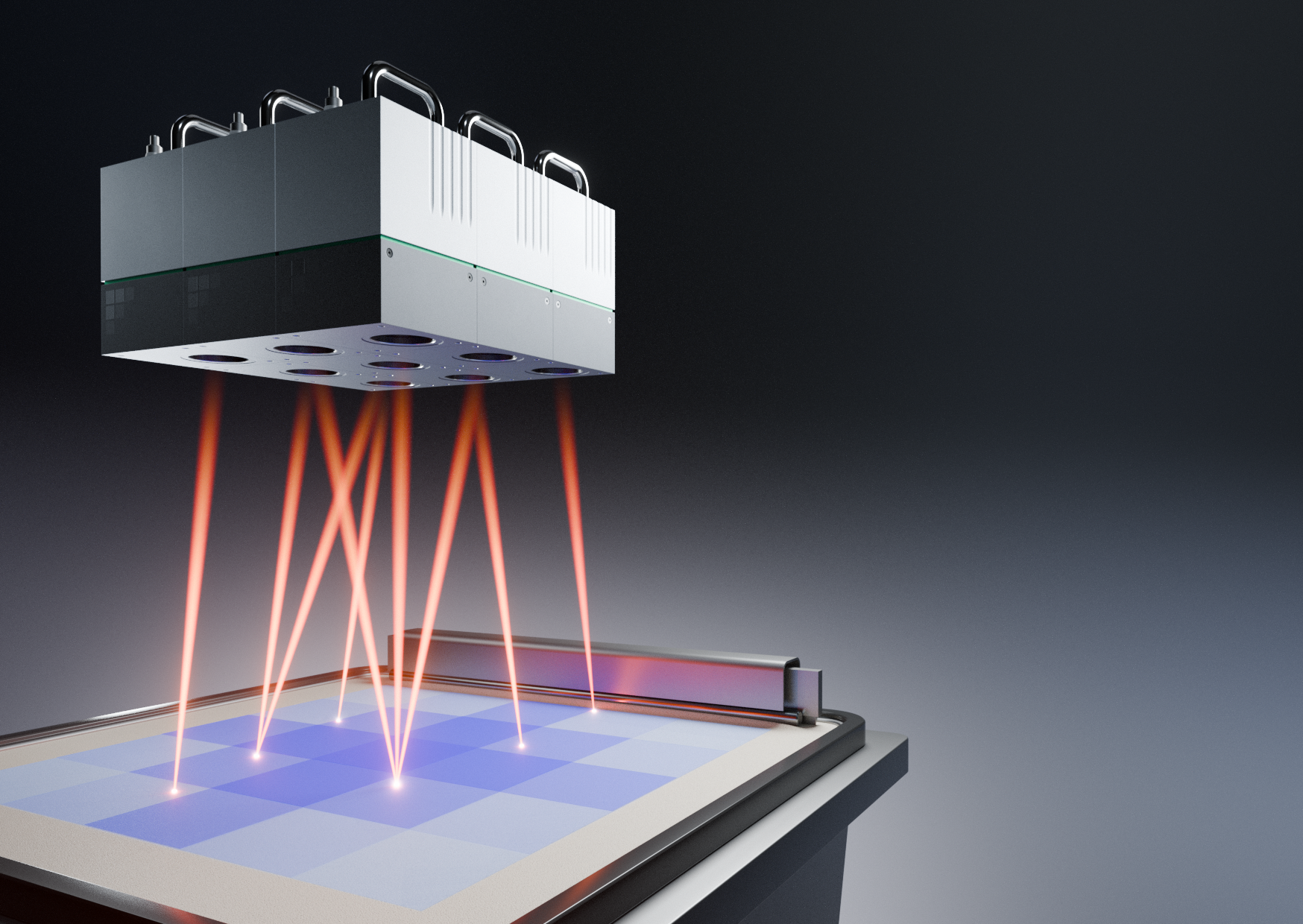
3 x 3 multi-scanner array consisting of planar galvanometer scanners with a 30-mm aperture. Greater overlap of the scan fields, combined with a larger build volume, results in higher productivity in additive manufacturing.

Multiply productivity with modular scanner arrays

The compact design of the PGS makes it possible to arrange multiple scanner heads into N x N arrays. Each scanner head independently positions a laser beam in up to three dimensions. This allows multiple processing steps to be performed simultaneously.

To test this concept, Fraunhofer ILT has built a demonstrator featuring four two-dimensional scanner heads, each equipped with an F-theta lens to test this concept. The system requires an installation space of only 140 × 140 × 90 millimeters. It was tested for marking and engraving at laser powers of up to 150 watts per scan head.

Robot-guided laser material processes

A PGS scan head that has already been built, with an aperture of 7 millimeters, has a volume of 50 cubic centimeters and weighs 60 grams. It was originally developed for a hand-held laser surgery application but is also suitable for industrial drilling, marking, and engraving processes.

The Planar Galvanometer Scanner as an enabler for many more applications

The PGS is designed for machine and plant manufacturers who need to position powerful laser beams quickly, precisely, and within a confined space.

Applications include:

  • Additive manufacturing
  • Multi-beam and multi-scanner systems
  • Laser cutting, drilling, and welding
  • Marking and engraving
  • Micromachining and surface modification
  • Paint and coating removal
  • UAV- or robot-guided laser processes
  • Semiconductor manufacturing, turbine construction, the cleaning of ship surfaces, and the perforation of fine filter structures.

Depending on the application, laser methods can also offer alternatives to electrochemical or wetchemical processing methods to make the specific process chain more environmentally friendly.

From a Fraunhofer Research Project to a Spin-off

At Fraunhofer ILT, the PIXIE startup team has developed the technological foundation for this innovative, already patented scanner. To bring it to market, the team is now spinning off the company.
© L. Bochvarov.
At Fraunhofer ILT, the startup team has developed the technological foundation for this innovative, already patented scanner. To bring it to market, the team is now spinning off the company.

Lazar Bochvarov developed the technological foundation of the PGS at Fraunhofer ILT. Together with Christina Giesen, Fabian Grimm, and Dr. Milena Žurić, the interdisciplinary team combines expertise in mechatronics, electrical and information technology, medical physics, and technology and innovation management in order to translate the PGS into products that elevate laser material processes. Moreover, the team is supported by the Fraunhofer Venture Network as well as by renowned experts and founders from the Fraunhofer ILT community.

As part of the “EXIST Research Transfer” program, the team is working on the commercialization of the scanner technology. This includes a redesign optimized for manufacturing, the further development of the control system, durability tests, the establishment of a supply chain, and initial deployments with pilot customers.

Interested in Exploring the Potential of the Planar Galvanometer Scanner for Your Application?

Are you planning a laser material process where installation space, weight, aperture size, laser power, or positioning dynamics limit performance? Would you like to control multiple laser beams in parallel to multiply productivity?

Team PIXIE is happy to work with you to determine how the PGS can provide value for your application!

Want to become a pilot partner?

Team PIXIE is working on initial deployments with pilot customers. If you want to test the PGS in your application, get in touch with us.

What wavelengths are possible?

The scanner can be manufactured to accommodate wavelengths for any known coating.

What aperture sizes are possible?

Successful tests were carried out with apertures of 7 mm and 26 mm. Larger apertures of 50 to 100 mm are considered feasible.

For which applications is this technology intended?

The PGS is designed for machine and plant manufacturers who need to position powerful laser beams quickly, precisely, and within a confined space. Applications include additive manufacturing, multi-scanner systems, laser cutting, drilling, and welding, marking and engraving, micromachining, paint and coating removal, and UAV- or robot-guided laser processes.


Relevante Pressemeldungen

How does this scanner differ from a conventional galvanometer scanner?

The mirror and motor form a single planar unit. This reduces installation space by nearly 90 percent and weight to about one-tenth, while the high torque-to-inertia ratio enables faster beam positioning, higher acceleration, and less dead time.

Relevant Press Releases