Equipment

Technical infrastructure

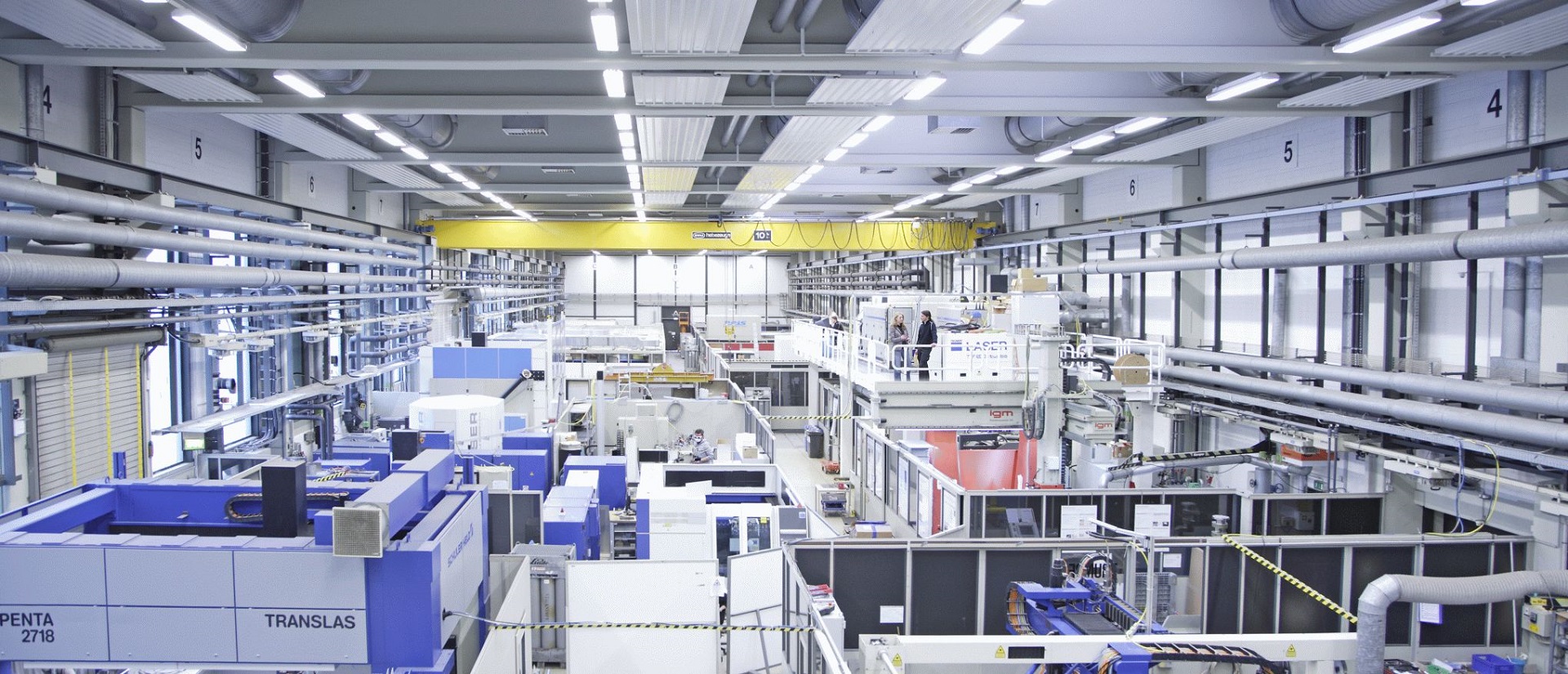
The technical infrastructure of the institute includes a mechanical and electronic workshop, a metallurgic laboratory, a photographic laboratory, a laboratory for optical metrology as well as a department for design and construction. The net floor area at the Fraunhofer Institute for Laser Technology ILT amounts to 19,500 m².


Equipment

The equipment of the Fraunhofer Institute for Laser Technology ILT is permanently being adapted to the state-of-the-art. At present, essential components are:  

Beam Sources

© Fraunhofer ILT, Aachen.
  • CO2 lasers up to 12 kW
  • Disk lasers up to 12 kW
  • Disk lasers with green wavelength up to 2 kW CW and QCW
  • Fiber lasers with 1.5 μm and 2 μm wavelength up to 200 W CW
  • Experimental lasers with 2 μm / 3 μm wavelength (ns, ps)
  • Experimental LIDAR lasers with pulse energies up to 500 mJ
  • Single- and multimode fiber lasers up to 6 k
  • Diode laser systems up to 12 kW
  • Single- and multimode fiber lasers up to 6 kW
  • Diode laser systems up to 12 kW
  • Multi kW ultrashort pulse lasers
  • Frequency-multiplied laser in visible spectral range
  • Excimer lasers amongst others with optical line systems
  • Broadband tunable lasers
  • MIR lasers (ps, ns) with average power > 10 W
  • Laser platform for satellite-based LIDAR systems


Plants and Processing Systems

  • Three-axis processing stations
  • Five-axis gantry systems
  • Robot systems including six-axis articutated robot
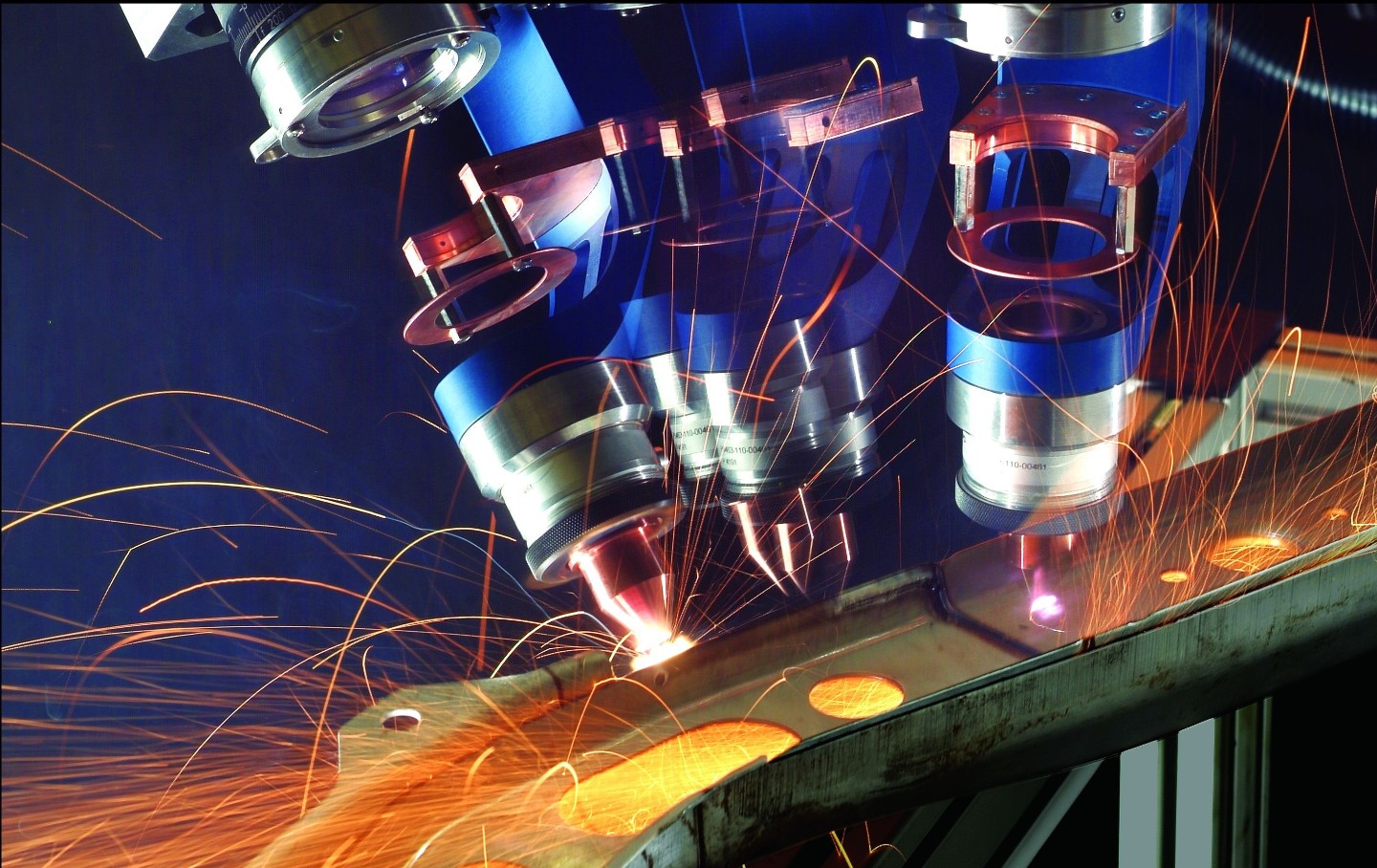
  • Tripod system for the extreme high speed laser material deposition EHLA
  • Commercial engineering and laboratory systems for laser powder bed fusion (LPBF)
  • Direct-writing and laser-PVD stations
  • Various powder and wire feed systems for additive manufacturing
  • Printer for sol-gel-hybrid polymers and nano- to microscale dispersions
© Fraunhofer ILT, Aachen.

Measurement and Sensor Technology

© Fraunhofer ILT, Aachen.
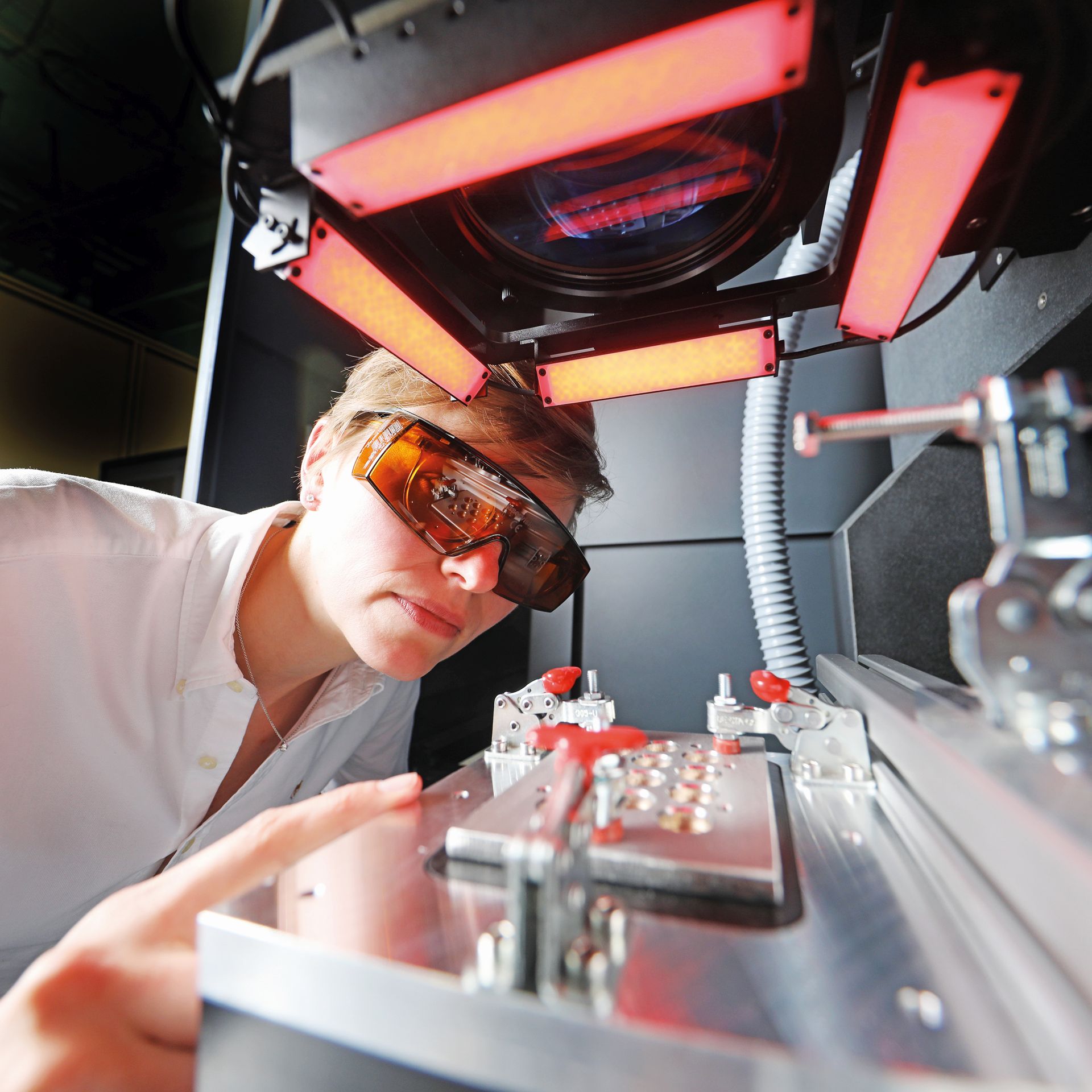
  • Devices for process diagnostics
  • Laser spectroscopic systems for the chemical analysis of solid, liquid and gaseous materials
  • Confocal laser scanning microscopy
  • Scanning electron microscope
  • Shack Hartmann sensor to characterize laser beams and optics
  • Measurement interferometer and autocollimator to analyze laser optics
  • Measurement equipment to characterize ultrashort pulse lasers
  • Equipment for vibration tests
  • Climate chambers for thermal tests with continual monitoring of the optical properties
  • Single photon detector (APD) for NIR lasers
  • Systems to characterize powder material
  • Measuremet system for single quantum detection

Battery Lab

At the Fraunhofer ILT Battery Lab, researchers focus on optimizing key parameters of batteries, such as capacity, energy density, performance, weight, charging time, charging cycles, chemical composition, and production parameters. The aim is to develop powerful, safe, and cost-effective batteries that meet the specific requirements of various areas of application.

Covering an area of almost 140 square meters, scientists have access to state-of-the-art technologies and a wide range of equipment for laser-based battery production. They are researching new materials and processes for both conventional lithium-ion batteries with liquid electrolytes and future solid-state batteries. Electrical and mechanical test benches enable them to directly evaluate and further optimize the laser processes.

The Battery Lab is equipped with an argon-powered glove box system that integrates vacuum-based PVD coating technology and a high-temperature furnace. This allows researchers to coat air-sensitive solid-state cell materials and then install them in test cells.

Additionally, they are investigating the possible applications of laser technology for cutting and welding battery components in the Battery Lab. The use of UKP lasers enables precise and damage-free processing of electrode foils. The Fraunhofer team connects battery cells to battery modules and modules to battery packs in order to make conventional production processes more efficient.

Setting up a laser welding machine for the assembly and contacting of battery modules.
© Fraunhofer ILT, Aachen, Germany / Andreas Steindl.
Setting up a laser welding machine for the assembly and contacting of battery modules.

Hydrogen Lab

Fraunhofer ILT already has experience and success with ZIM networks. They serve as a platform exchanging communication and knowledge between companies and R&D partners.
© Fraunhofer ILT, Aachen, Germany.
Fraunhofer ILT already has experience and success with ZIM networks. They serve as a platform exchanging communication and knowledge between companies and R&D partners.

By establishing its own hydrogen laboratory, the Hydrogen Lab, Fraunhofer ILT has created the ideal conditions for perfecting fuel cells as the core component of hydrogen technology – from the fundamentals to series production. The Hydrogen Lab's wide range of technical equipment opens up a variety of opportunities for seamless interdisciplinary collaboration. For public projects and industrial collaborations, it offers a unique space for achieving synergy effects at the highest scientific and technological level.

Fraunhofer scientists are conducting research in various projects to advance the cost-optimized and demand-oriented series production of fuel cells. They are tapping into technological and economic potential and accelerating the structured rollout in industry and society.

The new Hydrogen Lab covers 300 square meters and offers a wide range of laser-based test facilities for different dimensions and designs. These facilities cover the laser-related manufacturing steps along the process chain for the production of metallic bipolar plates used in fuel cells.

Individual manufacturing steps as well as process chains can be examined and evaluated on systems for structuring with ultrashort pulse lasers, for laser-based coating, and for high-speed welding and cutting. The test benches allow laser-manufactured components to be thoroughly tested for hydrogen tightness and efficiency.

Special Laboratories

  • ISO 5 and ISO 7 clean rooms for assembly and characterization of lasers and laser optics
  • Clean rooms for assembly of diode and solid state lasers as well as laser optics
  • Life science laboratory with S1 classification
  • Battery Lab
  • Hydrogen Lab
  • Application laboratories for USP applications